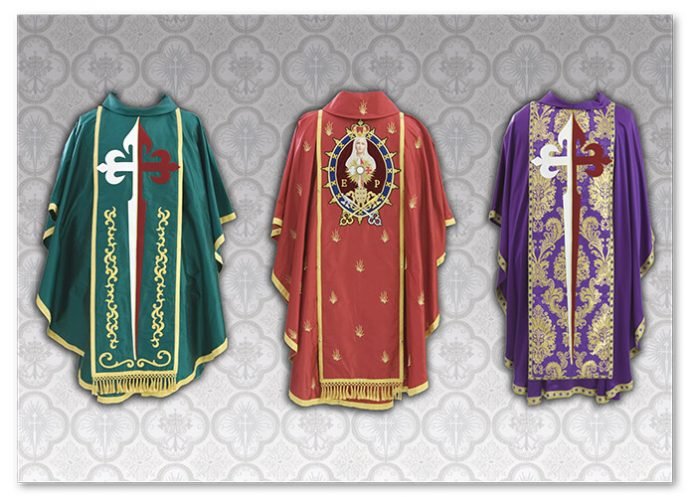
When Colour Speaks Louder Than Words
Lenten vestments in purple are one of the most quietly powerful signals in the entire Catholic liturgical year. Lent does not arrive with fanfare — it slips in with ash on the forehead and a subtle shift in atmosphere that is visual, musical and deeply spiritual. The Gloria falls silent. The Alleluia is packed away like a winter coat you’re not quite ready to put on yet. And the colours of the church change their mood entirely.
Within this liturgical context, Lenten vestments in purple according to the liturgical calendar clearly express the penitential and reflective character of the season.
Vestments are not decorative whims or aesthetic choices left to the taste of whoever’s ironing them that morning. They are theological statements in fabric form. This piece explores how they communicate meaning, how their colours have evolved through the liturgical calendar, and why these shifts still matter to the faithful today.
The Liturgical Calendar and the Language of Colour
The Church year unfolds like a carefully composed piece of music. Each season carries its own dominant note, and colour is one of the clearest ways that note gets sounded. From the expectant violet of Advent to the blazing white of Easter Sunday, vestments teach without uttering a single word.
I find this remarkable, honestly. Before the priest opens his mouth, before a reading is proclaimed, the colour of his chasuble has already begun its quiet sermon. Purple — or violet, in stricter liturgical terminology — signals repentance, preparation and sober reflection. It is the colour of royalty subdued, of glory deliberately restrained, of joy delayed but never denied.
During Lent, purple invites the faithful into something specific: examination of conscience, prayer, fasting and almsgiving. The four great disciplines of the season, and the vestments underscore all of them without saying a word.
Why Purple — The Symbolism Behind the Shade
Purple has carried layered symbolism through both Scripture and history for longer than most of us have appreciated. It is worth pulling that apart a little.
- Penitence and humility — echoing the ancient tradition of sackcloth and ashes, a turning inward before turning outward again.
- Royal dignity — a reminder of Christ’s kingship, paradoxically and powerfully revealed through suffering rather than triumph.
- Preparation — a spiritual in-between colour, neither the stark mourning of Good Friday nor the explosive white of Easter morning.
Historically, the dyes required to produce a true, deep purple were extraordinarily rare and expensive. Tyrian purple, extracted from sea snails off the Lebanese coast, was worth more than gold by weight. Its use in liturgy wasn’t just aesthetic — it silently linked Christ’s Passion with the language of kingship. That’s a theological irony the Gospel writers clearly relished, and the liturgy carries it forward in fabric.
See also: How Technology Supports Smart Manufacturing
The Liturgical Shifts That Come With Lent
Lenten vestments don’t exist in isolation. They form part of a much wider seasonal adjustment that reshapes the entire texture of worship, and it’s worth understanding each piece of that shift.
The removal of the Gloria and the Alleluia might seem like minor liturgical housekeeping to the uninitiated, but anyone who has sung them week after week knows the weight of their absence. It is a deliberate heightening of anticipation — a held breath before the Easter Vigil releases everything with extraordinary force.
Decoration follows suit. Floral arrangements become restrained. Musical accompaniment is stripped back. The visual austerity is not about dreariness — it is about focus. When the ornamentation quiets down, something else comes forward.
Rose on Laetare Sunday — A Moment Worth Noting
On the Fourth Sunday of Lent, something interesting happens. The tone briefly and beautifully softens. Rose vestments may replace purple — and if you’ve only ever encountered the purple of Lent week after week, that soft blush of rose can feel almost startling.
It is called Laetare Sunday, from the Latin “Rejoice.” It is not a break from penance — it is a reminder that Lent is moving somewhere. The destination is resurrection, not gloom. The rose vestment functions a bit like the first hint of spring light breaking through February cloud. You’re still in winter, but now you know it won’t last forever.
From Early Church to Modern Calendar
In the early centuries of Christianity, vestment colours were far less standardised than they are today. Regional practice varied enormously — what was worn in Rome might look quite different from what appeared in Gaul or North Africa. It was only through the Middle Ages that colour symbolism became systematised, eventually finding formal expression in the Roman Missal.
The liturgical reforms following the Second Vatican Council retained purple for Lent while clarifying its meaning within the broader renewal of the rite. This is worth noting. In a period of significant change, purple stayed. It stands as a quiet testimony to continuity amid reform — the kind of thing that speaks well of an institution’s instinct for what is genuinely essential.
Why Lenten Vestments Still Matter
In an age understandably suspicious of symbols, vestments continue to preach. They speak to the senses before the homily begins, before the congregation has had their second attempt at remembering the responses. They remind clergy and laity alike that Lent is not a self-improvement project dressed in religious language. It is a participation — in Christ’s forty days in the desert, in the ancient rhythm of preparation and purification.
The shift to purple is not cosmetic. It is catechetical. It slows us down. It invites seriousness without despair and penitence without theatrical gloom. And perhaps that is the quiet genius of the liturgical calendar: long before we articulate what Lent means, we have already seen it in the vestments of whoever stands at the altar.
Fabric, Faith and What It All Points Toward
Lenten vestments are not relics of medieval fussiness kept around out of habit. They are deliberate, doctrinal and deeply pastoral. Through colour, restraint and rhythm, the Church guides the faithful into a season of purification and genuine hope.
Purple does not shout. It waits. And in its patient waiting, it prepares the Church for the full, unrestrained blaze of Easter white — and that, when it finally arrives, is all the more extraordinary for everything the Lenten vestments in purple have held back.